Blood Bought
You walk in and the grading starts before you have found a seat.
The parking was tight. Note that. The music was a little loud, or maybe not loud enough, and the songs were ones you did not know. The kids' wing looked clean. The greeter was warm or the greeter was strange. The sermon ran long. You felt something or you felt nothing, and somewhere in the back of your mind a small clipboard fills itself in without your permission. Does this one have what I need. Is this the right fit for my family. Is this worth the drive.
I have run that checklist. I have sat in a service and graded it like I was deciding whether to keep a streaming subscription or cancel it before the trial ended. Too much of this. Not enough of that. I would not have said it out loud. We almost never say it out loud. But the question is running underneath everything, quiet and constant, the way the question runs when you are shopping for a gym or a phone plan. What am I getting out of this.
And the strange part is that church gives that question a religious vocabulary so we do not have to feel bad about it. We do not say I am a consumer and this is a vendor and I am checking the value. We say, I am just not being fed here. We say, I am not being nourished. We say, I need a church that meets me where I am. Same clipboard. Holier handwriting.
So before we get anywhere near an answer, sit in the question a second. Is that the relationship you actually have with the church. Customer and store. Is that what this is.
One Sentence on a Beach
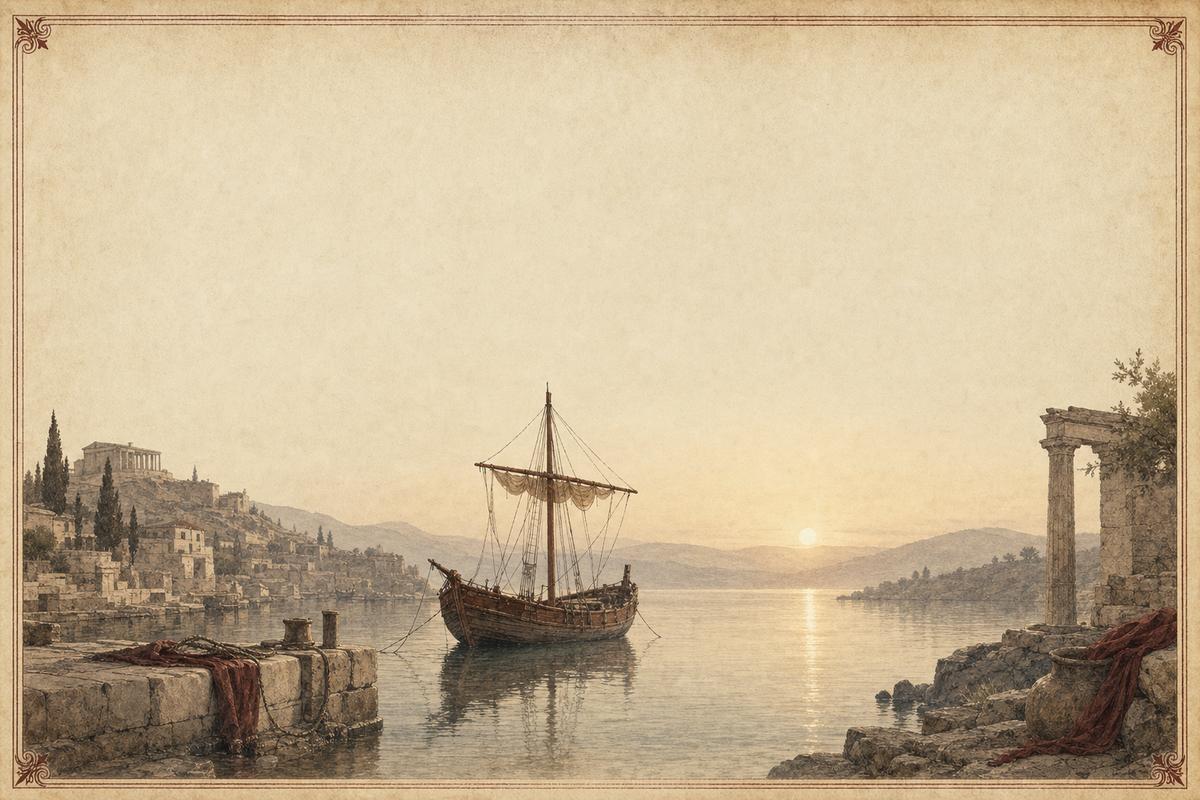
There is a beach at Miletus where a man is saying goodbye, and he knows it is the last one.
Paul has sent up the coast for the elders of the church at Ephesus. Three years he spent with these men. Three years of teaching and weeping and walking with them through a riot that tried to stop God and could not. Now there is a ship in the harbor waiting to carry him toward Jerusalem, and he already knows what is up the road. "In every town the Holy Spirit warns me that chains and afflictions are waiting for me" (Acts 20:23). He is not guessing. He is going anyway.
So this is the last conversation. He will not see these faces again, and he knows it, and they are about to find it out.
What do you say? That is the thing I keep stopping on. What do you say when it is the last time? You could say almost anything. You could give advice about the budget. You could warn them about the troublemaker three rows back. You could tell them you love them and leave it there, and no one would have blamed him.
I have tried to imagine it for myself... If I knew I was never coming back, if this was the final sentence I got to leave with the people I had poured my life into, what would I reach for. I am not sure I would reach for the right thing. I think I would reach for something about me.
Paul reaches for something about the church. One sentence. And it cuts straight through the clipboard.
Purchased
Here is the sentence. "Be on guard for yourselves and for all the flock of which the Holy Spirit has appointed you as overseers, to shepherd the church of God, which he purchased with his own blood" (Acts 20:28).
Watch where the weight falls. We want it to fall on the overseers, because we like sentences about leaders and roles and who is in charge. The Greek word there is episkopoi, guardian, the one who keeps watch. The word is right there in the verse — but the verse is not really about them. It is about the flock and what the flock cost. The overseers are there because of the price.
Which he purchased with his own blood.
The church was bought. That is what it is. Not gathered, not recruited, not assembled out of people who liked the same music. Bought. There was a transaction, and there was a price, and the price was blood. The phrase Paul uses is closer to "the blood of his own One." His own. The way you would speak of the one person you love more than your own life. God purchased the church, and the currency was his Son.
I want to slow all the way down here, because this is the part we move past.
Purchased is not a figure of speech. It is not a warm way of saying God cares. The person sitting next to you on a Sunday, the one whose name you are not sure of, the one whose politics annoy you, the one who sings off key. That person cost God his Son. And you cost God his Son. The same price for both of you. Not a discount because you have been here longer. Not a markup for the broken. The blood of his own One, spent on you.
I do not know exactly how to hold that. I want to tell you I do. I can preach the cross. I am not sure I have let myself be the thing that was bought at the cross. Those are not the same. One is a doctrine I can preach. The other is a price tag hanging off my own chest, and when I turn it over and read the number, the number is the blood of God's own Son.
Sit there a second. Do not rush you past it. We are so quick to get to the comfort that we never feel the cost. And we do not feel rescued when we will not admit we needed rescuing. The blood was real. The Son was real. The wanting was so strong that it spent him.
So if God paid that, willingly, without flinching, without adding it up and deciding you were too expensive, then the clipboard question dies on the spot. The question was never what do I get out of this church. The question is what does it mean that I cost that much.
What You Cost
Stay on the price, but turn it over, because there is something on the other side of it.
We hear blood and we think payment, and payment makes us think of something owed, something grudging, a bill that had to be settled. So hear this clearly. God did not pay reluctantly. He did not stand over the cost of his Son and sigh and decide it was unfortunately necessary. He was not cornered into it.
He wanted you.
That is the whole engine of it. Luke tells a story about a father whose son took the money and ran and burned through all of it, and one day the father looks up and sees a shape on the road that is still a long way off, too far to recognize by any normal measure, and the father knows it anyway, and the father runs. "But while the son was still a long way off, his father saw him and was filled with compassion. He ran, threw his arms around his neck, and kissed him" (Luke 15:20). Fathers in that world did not run. It was undignified. He ran anyway. He could not get to the boy fast enough.
That is the heart behind the price. God looked down the road, saw you while you were still a long way off, and spent the blood of his own Son to bring you home, because he wanted you in the flock. Not the idea of you. You. The specific one. Not humanity in the abstract, not a number in a sanctuary, you with your name and your record and your particular way of wandering.
I think about my worst days when I read that. The days I feel small. The days I feel forgotten, replaceable, like the work would go on fine without me and maybe better. I have those days. Pastors are not exempt from them, we just hide them better. And on those days the math in my head says I am not worth much, and the math is loud, and the math feels like honesty.
And then there is this number. The blood of his own One. That is what God was willing to spend on the small forgotten replaceable version of me. Not the polished one. That one. I cannot make the math in my head and the math at the cross agree, and I have stopped trying to, because one of them is lying and it is not the cross.
Someone looked at you and decided you were worth his Son. Specifically. Not theoretically.
And things that cost that much do not get left lying around. Blood-bought things get guarded.
So Someone Stands Watch
Now the overseer shows up.
The reason there is a shepherd at all is the blood. Paul says it in the same breath, "the Holy Spirit has appointed you as overseers, to shepherd the church of God" (Acts 20:28). The Holy Spirit appointed them. Not Paul. Not a vote. Not a search committee with a list of qualifications. The Spirit set men over the flock because the flock was worth setting men over.
And then the warning. "I know that after my departure savage wolves will come in among you, not sparing the flock. Men will rise up even from your own number and distort the truth to lure the disciples into following them" (Acts 20:29-30). Wolves are coming. Some from outside, some from your own row. And the severity of the warning is not Paul being dramatic. You guard a thing the way you priced it. You do not post a watchman over what is cheap.
If you lead anything in a church, you already feel the weight of this. You are not managing volunteers. You are not running a program with a turnover problem. You are standing watch over a flock that God paid for with his Son, and the watching costs something, and it is supposed to. A man does not walk away from what cost him everything. He stands in the gap for it.
But here is the thing we cannot miss. The real guard was never Paul. Paul was about to get on a ship and be gone.
The Ship
So watch what he does with them. He does not say good luck. He does not say it is all on you now. He hands them off.
"And now I commit you to God and to the word of his grace, which is able to build you up and to give you an inheritance among all who are sanctified" (Acts 20:32). Commit. It is the word for setting something into safe hands, the word for entrusting. It is the same kind of word Jesus used when he said from the cross, "Father, into your hands I entrust my spirit" (Luke 23:46). Paul does with the church what Jesus did with his own life. He places it in the Father's hands. Not into the elders' hands. Into God's.
And he does not hand them a strategy. He hands them "the word of his grace," and he says it is the word that builds, the word that secures the inheritance. The word does the work. And the word carries something, or rather Someone. It carries a living Christ. Paul will be in chains. Paul will die in Rome. And the word of grace will still be standing in Ephesus long after the man who preached it is gone, because the One the word carries does not die and stay dead. He got up.
That is the difference between two goodbyes. One goodbye leaves you on your own. Good luck, do the best you can. The other says, I am putting you into hands stronger than mine, and those hands are not going anywhere.
Then it ends the way real partings end. "After he said this, he knelt down and prayed with all of them. There were many tears shed by everyone. They embraced Paul and kissed him" (Acts 20:36-37). They wept. They held on. They walked him down to the ship.
Paul got on the ship. Jesus never did.
We have all done some version of this. We hold our lives in our own hands and call it strength. We sit in a church for years and never quite make it ours, never stop grading it from the back row, never get off the customer's side of the counter. I am not standing over anyone on this. I have a clipboard of my own.
The Shepherd bought us, stood watch over us, and never sailed away. He is still here. Still wanting us in the flock.
He never got on the ship. Will you get off yours?
Yours in Christ,
Mike Palmer
Pastor, Red River Baptist Church
P.S. If you read all of that and the clipboard is still in your hand, do not panic and do not perform. Just come Sunday and sit down. You do not have to grade the place. You were bought, not browsed. Let that be enough for one week, and we will take the next week when it comes.
This article is drawn from a recent sermon in the "Acts" series at Red River Baptist Church, "What He Left Behind," Acts 20:17-38.