He Is Still Waiting on Your Answer
God’s plan was certain. Mary’s will was real. What question is still waiting on your answer?
Dear Church Family,
Subscription creep is the slow, invisible accumulation of recurring monthly charges. Start a trial, forget about it, and bam... another $9.99/month added to your life.
There are even apps to sniff out forgotten subscriptions and help you cancel them. Ironically, they also require a monthly subscription. Go figure.
Autopilot is the name of the game today. Surveys show that 91 percent accepted terms and conditions without reading a word. For the eighteen to thirty-four crowd, it was 97 percent. I am in that number. So are you, probably.
Power in today’s culture enrolls us automatically, and we let it. Being asked slows everything down. Being asked means I have to answer, and answering means it is on me now.
We despise waiting. Buffering. Lines. Texts. Emails. Phone calls. When is the last time something actually waited on your word? Not a checkbox. A real question that stood there and refused to move until you spoke.
Heaven Did Not Auto-Enroll Her
Gabriel was sent by God to Nazareth, to Mary, a virgin engaged to Joseph (Luke 1:26-27).
Picture it. Nazareth. Not Jerusalem. Not the temple. Not anywhere a decent publicist would have picked. A town so unremarkable that when someone later says the Messiah comes from there, the response is a sneer: “Can anything good come out of Nazareth?” (John 1:46).
And in that town, a teenage girl. Engaged, not fully married. No title. No position. No record of anything she has done.
And the angel greets her: “Greetings, favored woman! The Lord is with you” (Luke 1:28). Favored from the start, before we know anything about her.
This is God coming to a nobody in a nowhere town with his worldwide salvation project. If I had written the scene, it might have been a notification in the background. Salvation processed. No action needed.
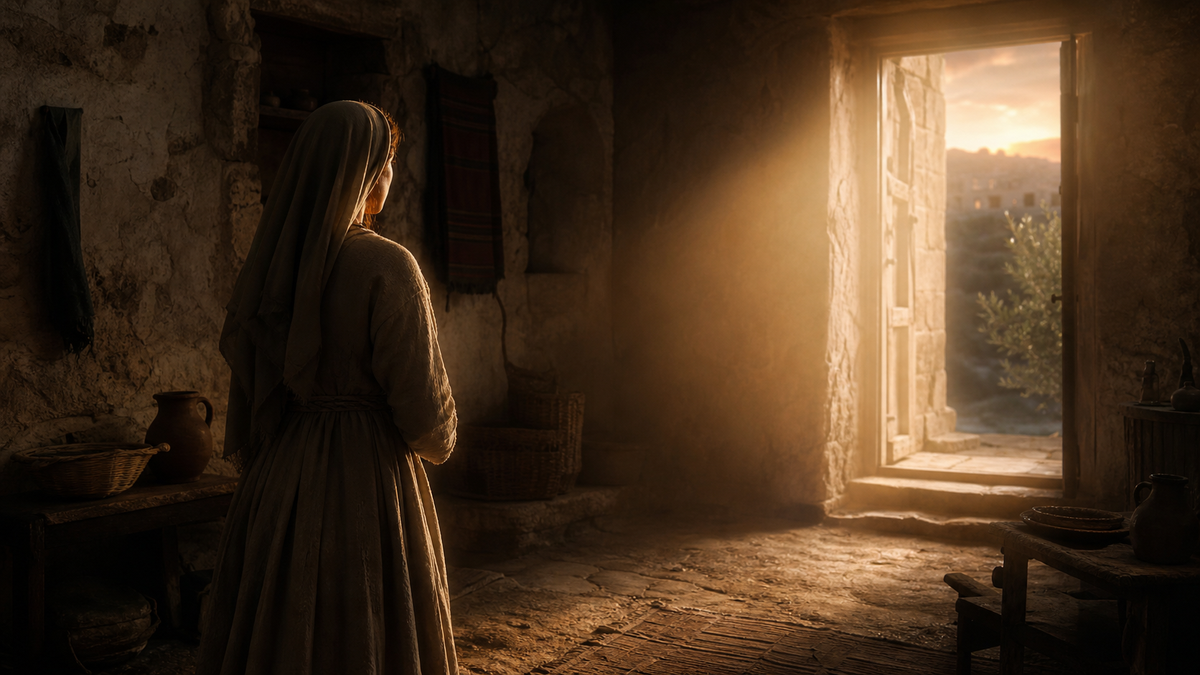
But Mary was not a bystander in God’s plan. Luke says she was deeply troubled by the greeting. By verse 38, we have Mary’s answer. Between now and then, Mary is turning these things over in her own mind. She matters. And there is a sense in which God is waiting on her.
The Decree That Came Looking for Her
Gabriel says Mary will conceive and give birth to Jesus, and the Lord God will give him the throne of his father David. “He will reign over the house of Jacob forever, and his kingdom will have no end” (Luke 1:30-33).
Listen to the verbs. You will conceive. The Lord will give. His kingdom will have no end. Settled future facts, every one of them. This is not a marriage proposal. This is a herald delivering a decree.
A decree that goes back nine hundred years to David: “I will establish the throne of his kingdom forever” (2 Samuel 7:13). Collapse. Exile. Silence. Kingdoms fell. The temple burned. And when heaven finally speaks again, nothing has been dropped. Nothing negotiated.
What kind of God keeps a promise like that? I cannot keep a promise through one hard summer.
Announcement or Invitation?
God is not asking Mary whether the plan is a good idea. That was decided before she was born. But he has walked the promise out of the paperwork and stood it face to face with a person. A promise only God could keep, now standing in front of a teenage girl, waiting on her word.
Hers. Do you see that? If it is all announcement, why does the angel not leave immediately?
Mary is troubled by this. She is engaged, and her engagement was as binding as marriage itself. The law she grew up under named what was supposed to happen to a betrothed woman found pregnant by a man who was not her husband (Deuteronomy 22:23-24).
Nazareth was a small town. Things travel fast in a small town. Small towns do not forget. The story would follow her to every doorway she ever stood in. Yet God picked this girl in this town on purpose.
She said yes to all of that. Not to pregnancy in the abstract. To the actual, specific, name-in-every-doorway consequences of a story nobody in that village would ever fully believe.
“The box costs the checker nothing, and that is exactly why nobody bothers to ask anymore.”
I have said plenty of yeses like that. Cheap ones. Yeses that cost me nothing and therefore changed nothing. There is a difference between agreeing and answering, and I know which one I do more of.
The Angel Did Not Leave Until She Spoke
Mary had one question for the angel. Not, how can I know this? Just, how can this be? (Luke 1:34). She was not asking for proof. Gabriel answered her, then handed her a sign she never asked for: Elizabeth, six months along, an old woman everyone had written off as childless.
“The Holy Spirit will come upon you, and the power of the Most High will overshadow you” (Luke 1:35).
Notice something. Gabriel never asks, “Will you?” It was an announcement from start to finish. And yet the angel does not leave until she responds. The box left unchecked. The question left open on purpose.
Her yes is not resignation. She is troubled. She is thinking. She is reaching for a plan and taking hold of it as her own. Her answer is her alignment with God’s purposes.
We have two things that have to stay true at once. God was never in heaven waiting nervously to see if a teenager in Nazareth would cooperate. And Mary’s answer was never make-believe.
God’s plan was certain. Mary’s will was real. Scripture never asks you to pick between those two. Of course God did not need Mary to save the world. Yet he included her anyway. Gabriel did not leave until she responded.
Grace Gave Her the Yes
“See, I am the Lord’s servant,” said Mary. “May it happen to me as you have said.” Then the angel left her (Luke 1:38).
Grace is what produced Mary’s response. And grace is the only thing that will ever produce ours: our willingness to align ourselves with his purposes, our yes to God’s plans.
The Yes, Finished
Thirty-three years later, Jesus, just hours from the cross, prays: “Father, if you are willing, take this cup away from me—nevertheless, not my will, but yours, be done” (Luke 22:42).
Hers in Nazareth, his in a garden. Not a slogan, but the same posture. Each one knowing what it would cost, bending their will toward the Father and truly meaning it.
And Jesus’ yes meant that whatever he took up as the Son in Mary’s womb, he never put back down. His body went all the way to the tomb. And on the third day, the same Spirit who overshadowed a virgin in Nazareth would not leave that body there.
Our yeses to God matter because they are our surrender to him. God uses them as a doorway to work into the world. He used Mary’s yes as a doorway to the resurrection of Christ. Of course he could have done this without her. But that is not the God we serve.
The empty tomb is Mary’s yes, finally finished.
What Is Still Waiting on Your Answer?
So many things in life are decided for you, enrolled automatically, renewed automatically, and agreed for you by the way. God gives us free will and a power that will not check the box for you. Not auto-include you.
This is one of the great gifts of being human: to willingly and knowingly align ourselves with the purposes and plans of God. That our lives could be used as a doorway for Christ to work through us in this world.
When is the last time you said yes to God about anything going on in your life? Not the yes you may have given decades ago when Jesus became your Lord and Savior. I mean the one he is waiting on this week.
Is there a question still sitting open in your life that you have politely declined to answer?
When Mary spoke, Luke says, “Then the angel left her.” He left because the answer came.
Is there a question still lingering around you, waiting for your response?
Yours in Christ,
Mike Palmer
Pastor, Red River Baptist Church
P.S. Some of you already know the question. You have known it for a while. You have just kept moving around it, hoping silence would count as an answer. It does not. But grace is still standing there. Not with a chisel. Not with a threat. Just waiting for the yes you are afraid to give.
This article is drawn from the third sermon in the “Christmas in July” series at Red River Baptist Church—“He Waited on Her Answer,” Luke 1:26-38.