How Can I Know?
The Record
Our church records go back a long way. Two years ago, at our 175th anniversary, I shared some of what I found in them. Red River Baptist Church, Benton, Louisiana. Thirteen people started it in 1849, and from the beginning somebody kept the minutes.
Members were brought before the church for dancing. For swearing. For fishing on Sunday. One entry lists a charge of “gaming of the Sabbath.” And one member “tasted of the bottle and walked tipsy in the presence of a neighbor.” Not drunk. Tipsy. Somebody saw, and somebody wrote it down.
Go ahead and laugh. I would have made the book… Probably you too,
But somebody thought holiness mattered enough to write it down. And what got written down is that the people of this church were not impressive. That is their own handwriting.
So one hundred seventy-seven years later, the story of this place is not that Christians are impressive. It is that God is faithful to people who are not.
We are not still here because our faithfulness never failed… we are still here because his never did
What Exactly Are You Offering Me? (Genesis 15:1-6)
After these events, the word of the Lord came to Abram in a vision: Do not be afraid, Abram. I am your shield; your reward will be very great. But Abram said, “Lord God, what can you give me, since I am childless and the heir of my house is Eliezer of Damascus?” Abram continued, “Look, you have given me no offspring, so a slave born in my house will be my heir.” Now the word of the Lord came to him: “This one will not be your heir; instead, one who comes from your own body will be your heir.” He took him outside and said, “Look at the sky and count the stars, if you are able to count them.” Then he said to him, “Your offspring will be that numerous.” Abram believed the Lord, and he credited it to him as righteousness.
But he said, “Lord God, how can I know that I will possess it?” (Genesis 15:8)
God speaks first. And Abram talks back. What exactly are you offering me? I have no son.
God does not tell him to have more faith. He takes him outside. Look up. Count them. You cannot.
Then verse 6. Believed. Credited. “Credited” is an accounting word. Paul picks it up in Romans: “to the one who does not work, but believes on him who justifies the ungodly, his faith is credited for righteousness.” (Romans 4:5) A gift, not a wage.
This church has a book where the failures got written down. God keeps a book too. And in Abram’s column, on a night when Abram had done nothing but complain, God wrote righteousness he did not earn.
Then verse 8. He already believed. And he asks anyway. God is not offended.
Maybe it is your question too. How can I know?
God answers him with an odd ritual.
Verses 9-10, He said to him, “Bring me a three-year-old cow, a three-year-old female goat, a three-year-old ram, a turtledove, and a young pigeon.” So he brought all these to him, cut them in half, and laid the pieces opposite each other…
Know This For Certain
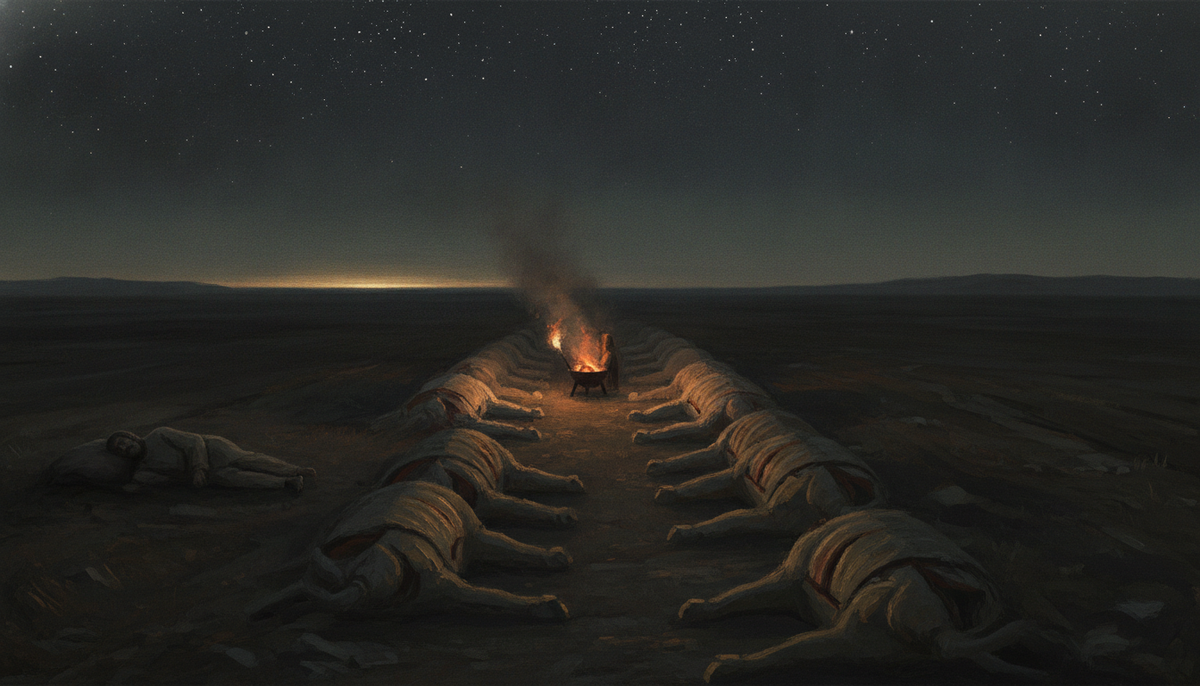
In Abram’s world you did not sign a covenant. You cut one. You killed the animals, cut them in half, and laid the halves in two rows with a path of blood between them. Then the one making the promise walked that path. And walking it meant… may this be done to me if I break my word. That was your signature. Usually it was the servant who walked, the lesser one. Like a loan… the bank has the money, but the borrower signs.
Verse 12, As the sun was setting, a deep sleep came over Abram, and suddenly great terror and darkness descended on him. Then in verse 13, the Lord said to Abram, “Know this for certain: Your offspring will be resident aliens for four hundred years in a land that does not belong to them and will be enslaved and oppressed.”
Abram never makes it to the path. He is asleep. God alone walks the blood oath.
In verse 8 Abram asked how can I know. In verse 13 God answers with Abram’s own verb, doubled. In Hebrew it is: knowing you shall know, the verb repeated for emphasis, the way we say I know that I know. God did not hand him a feeling. God handed him his own question back… with a promise on it.
Hear it the way Abram heard it. Flat on your back in the dark. Terror on you. And the God you just questioned says know this for certain, and the first certain thing out of his mouth is four hundred years of slavery. God put the dark years inside the promise but he already numbered them. A promise from God never meant there would be no dark years between the promise and the day it arrives.
Some of you are reading this from inside those years.
Between the cutting and the darkness: “Birds of prey came down on the carcasses, but Abram drove them away.” (Genesis 15:11) Nothing has been signed yet. Abram stands in a field for hours keeping the pieces whole. That is what the waiting years look like. He just keeps the birds off.
Verse 15, But you will go to your ancestors in peace and be buried at a good old age.
He asked how can I know that I will possess it. God said, you will die first. And the promise will land anyway. Thirteen people signed a book in 1849 believing exactly that.
So if the promise does not rest on Abram, who is asleep, and does not rest on the thirteen, who are dead… what is it resting on?
Only One Walked
Watch who walks the bloody path.
Verse 17, When the sun had set and it was dark, a smoking fire pot and a flaming torch appeared and passed between the divided animals.
One appearance of God, smoke and fire, the way he would show up at Sinai. Nothing in that field stands for Abram. Abram is asleep.
To pass between the pieces was to stand under the curse. Jeremiah saw it in his own day. God said of the ones who broke it, “As for those who disobeyed my covenant… I will treat them like the calf they cut in two in order to pass between its pieces.” (Jeremiah 34:18) The walk was a sentence. Let this happen to me if I break my word. And Genesis says it plainly: “On that day the LORD made a covenant with Abram.” (Genesis 15:18) “Made”… the Hebrew word is “cut”. God cut it. God walked it. Abram slept through it.
And only God walks. Remember that… God alone takes on the blood oath.
God stakes himself on his own promise. Hebrews says he had no one greater to swear by, so he swore by himself, so that “we who have fled for refuge might have strong encouragement.” (Hebrews 6:13, 18)
Which means when the promise is broken… the curse can only fall on the One who walked. Paul tells us where that logic goes. “Christ redeemed us from the curse of the law by becoming a curse for us.” (Galatians 3:13) The curse a broken covenant carried… Christ carried.
And if you are not in him, the curse is still yours. Being in a church building is not the same as being in Christ. Having your name on a church roll is not the same as belonging to the promise.
Abram brought the animals. He contributed nothing to the oath except the need for it. That does not make his faith meaningless. It makes it free.
Faith receives a signed document. Faith does not co-sign it.
So… how can I know? Not by measuring your faith. It wavers. Mine does.
Your faith is the hand… that receives. The covenant is the foundation. Weak hands drop things… but they land on the floor.
The gospel is news, not advice.
The darkness that fell on Abram at sunset fell again, at noon, over a hill outside Jerusalem. “When it was noon, darkness came over the whole land until three in the afternoon.” God does not stand at a distance and tell covenant-breakers to repair themselves. In Christ, God comes for them. And a covenant signed in a dead man’s blood guarantees nothing… if he stayed dead. Jesus Christ lived the life you owed, died the death you earned, and walked out of a tomb on the third day alive. That is the story of the whole Bible… God’s homecoming to us. He is not a memory this church keeps. He is alive.
Your hope is not that you will finally become the kind of person God can trust. Your hope is that Christ is the kind of Savior you can trust.
I am the one who keeps trying to re-sign what was already signed. I bring God my résumé.
You can quit bargaining with God.
You can quit keeping score.
You can quit bringing him your résumé.
You can quit wondering whether your worst year finally used up his mercy. It did not.
You never were the signer. Christ is enough.
God told Abram to count stars he could not count.
He Counted the Room
And if you belong to Christ, then you are Abraham’s seed, heirs according to the promise.
Abram could not count them. God could. And that night he counted a room in Benton, Louisiana. Thirteen names in 1849. The names on the rolls since. And a room in whatever town you are reading this in, on Paul’s condition. If you belong to Christ, you were in that sky.
In 1949 people gathered here to mark one hundred years. Every one of them is gone. We will be too. Somebody stood where I stand and is buried now. Somebody will stand here at two hundred, and it will not be me. The constant was never us. The constant is the promise of God.
God did not promise to preserve us as an institution. He promised to reclaim the nations as a people for himself. And for one hundred seventy-seven years this church has been one way for that enormous promise to reach people. We are not the story… but we are caught up in the story.
In Genesis 17, two chapters after the cutting, the obligations come, and they are plain enough: walk before me and be blameless, and take circumcision as the sign of what has already been sworn. Response, not price. The holiness in the record book came after the signature too.
And that is why there is a Table.
The Direction of the Meal
The Lord’s Table is the covenant in a sign you can hold. “You proclaim the Lord’s death until he comes.” (1 Corinthians 11:26) The direction of the meal runs God to us. The bread and the cup are not your offering to God. They are his offering to you. I do not come to that Table to prove anything. I come hungry.
On the last night of his life, in an upstairs room, Jesus picked up a cup. “This cup is the new covenant in my blood, which is poured out for you.” (Luke 22:20) That is God doing it again. Entering the covenant with covenant-breakers. Alone. In blood.
Wherever you hold that bread next, notice which way it is moving. Toward you. Do not come impressed with Red River Baptist Church. Do not even come impressed with your faith. Come impressed with Christ. Sinners have come and gone here for one hundred seventy-seven years. Christ remains.
And if you have never come to him at all… come now. Not to this church. To him. He signed it alone, he is alive, and the promise is for you.
We are not still here because our faithfulness never failed… we are still here because his never did
Source: The 177th anniversary homecoming sermon “Know For Certain” on Genesis 15:1-21, Red River Baptist Church, August 30, 2026.