Away with Him!
On July 27, 1996, Richard Jewell was working security at Centennial Olympic Park in Atlanta when he found a backpack under a bench. He reported it and started moving people away. The bomb went off while the area was still being cleared. One woman died. More than a hundred were hurt. Jewell had done exactly what he was trained to do.
For three days he was a hero.
On July 30 the Atlanta Journal Constitution named him the focus of the investigation. Not the man who found the bomb… the man suspected of planting it. He was never charged. On October 26 the Department of Justice cleared him.
Eighty-eight days. And the clearance never caught up with the crowd and media suspicion. When Jewell died in 2007 his name was still tied to a crime he helped keep from being worse. He did everything right, and the crowd came anyway.
That is not quite Paul’s story. But it puts you in the weight Paul walked into.
He Did Everything Right
Paul came to Jerusalem and reported what God had done among the Gentiles. The elders rejoiced… then handed him a rumor: he was teaching Jews to abandon Moses. Their answer: four men were finishing vows, and Paul could purify himself with them and pay their expenses, so everyone would see that “what they were told about you amounts to nothing” (Acts 21:24).
It was the elders’ plan, not God’s command. Paul took it. He spent his own money to answer a rumor and walked into the temple.
And it did not work.
If obedience cannot protect you, why obey? Hold that question.
They Supposed… and then Shut the Gates
Jews from Asia spotted Paul in the temple. They had seen him earlier in the city with Trophimus, a Gentile. That was enough. Luke gives the whole hinge in two words: “they supposed” (Acts 21:29). They supposed that Paul broke the Law by taking this Gentile into the temple.
Nobody investigated. A sighting became a supposition, the supposition became a fact, the fact became a mob. And Jerusalem had run this play before… false witnesses stood over Stephen with the same charges (Acts 6:13). Nobody checked then either. This is not a crowd that examined the evidence and got it wrong. This is a crowd that never examines. Verdict first… facts never.
They dragged Paul out of the temple he came to honor. “At once the gates were shut” (Acts 21:30).
The Same Cry
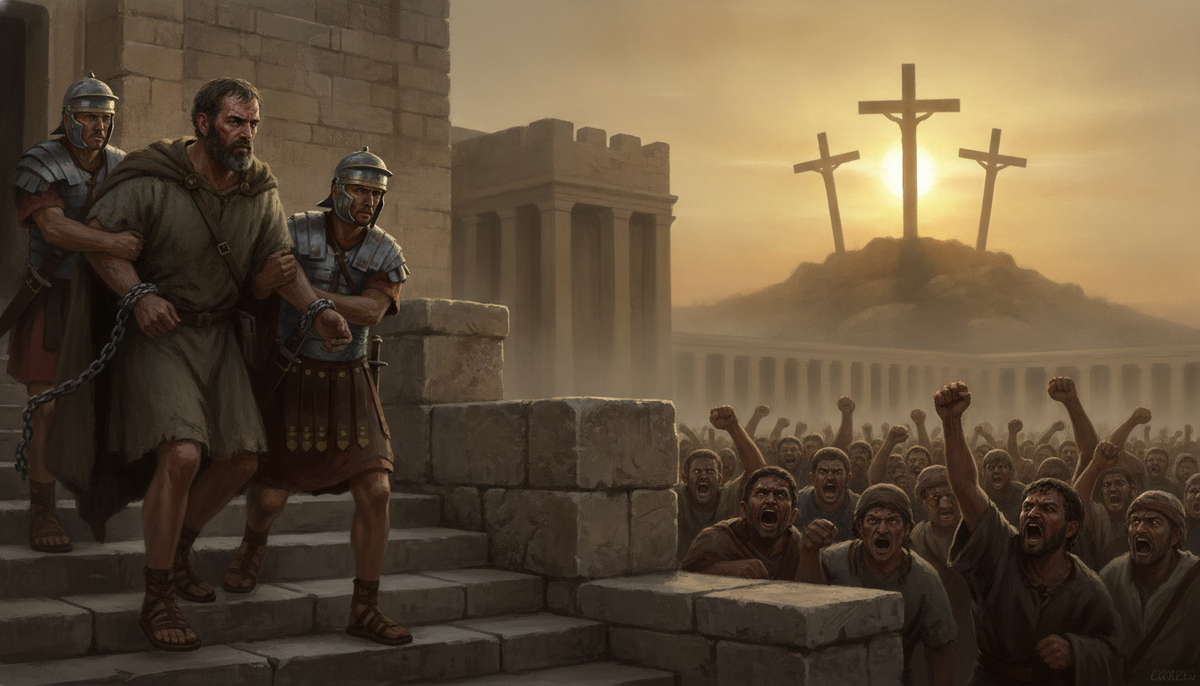
Soldiers pulled Paul out of the beating, chained him, and had to carry him up the steps while one cry followed: “Get rid of him!” (Acts 21:36).
The Greek verb means… take away, remove. It is the same imperative another crowd threw at Pilate: “Take this man away!” (Luke 23:18). John doubles it: “Take him away! Take him away! Crucify him!” (John 19:15). And the cry rises again over Paul a chapter later (Acts 22:22).
Same city. Same cry. One generation apart.
Jesus heard it first. Paul was not repeating the cross… Christian suffering is witness, never payment. Jesus alone carried sin.
The Man Who Used to Be in the Crowd
Years earlier, when this same city stoned Stephen on the same false charges, a young man stood in that crowd holding coats. One chapter after our passage, standing on these same steps, Paul confesses: “I stood there giving approval and guarding the clothes of those who killed him” (Acts 22:20). Paul was the young man. The man the crowd is dragging used to be in the crowd.
But before we judge the crowd… nobody ever joins a mob. You just repeat a verdict you never checked. That is all it took for the young man holding the coats.
Then the risen Jesus met him on the Damascus road. Not better instincts… resurrection. A living Christ who met a guilty man and gave him a new name, a new allegiance, and a road he never would have chosen.
The gospel is not that Jesus helps the admirable man on the steps. The gospel is that Jesus died for the people in the crowd… went to the cross for the guilty, and rose to claim them.
The Verdict That Lasts
Acts 21 gives Paul no clearing. It ends with him bound, carried up the steps, Jerusalem still shouting.
Two chapters later, “the Lord stood by him” (Acts 23:11) and sent his testimony toward Rome. The crowd meant an ending. God wrote an itinerary.
Paul had already written the sentence years earlier, from Ephesus: “It is of little importance to me that I should be judged by you or by any human court… It is the Lord who judges me” (1 Corinthians 4:3-4).
Jerusalem never cleared Paul. But… The Judge stood beside him (Acts 23:11).
And the last time Jerusalem shouted, “Away with him,” they got their way. The cross. The tomb. The stone, the seal, the Roman soldiers. The crowd that never checked the witnesses and never checked the rumor never bothered to check the tomb either… and three days later, their verdict was not final.
Saying yes to Jesus can cost you your name, your freedom, even your life… but the crowd never gets the last word.
The Door Is Open
Now come back to the question we have been holding… if obedience cannot protect you, why obey?
Look at what obedience bought Paul. He paid for the vows and got a riot. He submitted to the elders and got chains. If obedience is a lever for controlling outcomes, it failed him completely. But that is not what it is.
Obedience was never Paul’s protection… it was his testimony. The way a man who belongs to Jesus tells the truth about him with his life, whether the crowd believes it or not. Paul did not obey to secure a verdict. He obeyed because his verdict was already secure. The outcome belonged to the Judge… the witness belonged to Paul.
Maybe you obeyed and still could not control what happened. Maybe you live under a verdict from people who never knew the whole story. Or maybe, if you are honest, you have repeated a verdict you never checked… that is all crowd behavior, and it is exactly where Paul was found.
Is there one obedient thing you already know to do… even though it will not fix your name?
The door is open. The cross has answered your guilt. The tomb is empty… and he is not finished with you.
Source: The Acts sermon “Away with Him!” on Acts 21:17-36, Red River Baptist Church, August 23, 2026.