Let the Lord’s Will Be Done
There is a feature of love that is subtle, sneaky, and difficult.
The stronger your attachment to someone, the more desperately you will try to stop them from walking into something you cannot stop. A parent watching a child move across the country. A spouse choosing treatment with no guarantee. A friend volunteering for something dangerous. You stand there with all your words, all your power… and you have none. You cannot rewrite what is coming. There are people living in that exact moment right now.
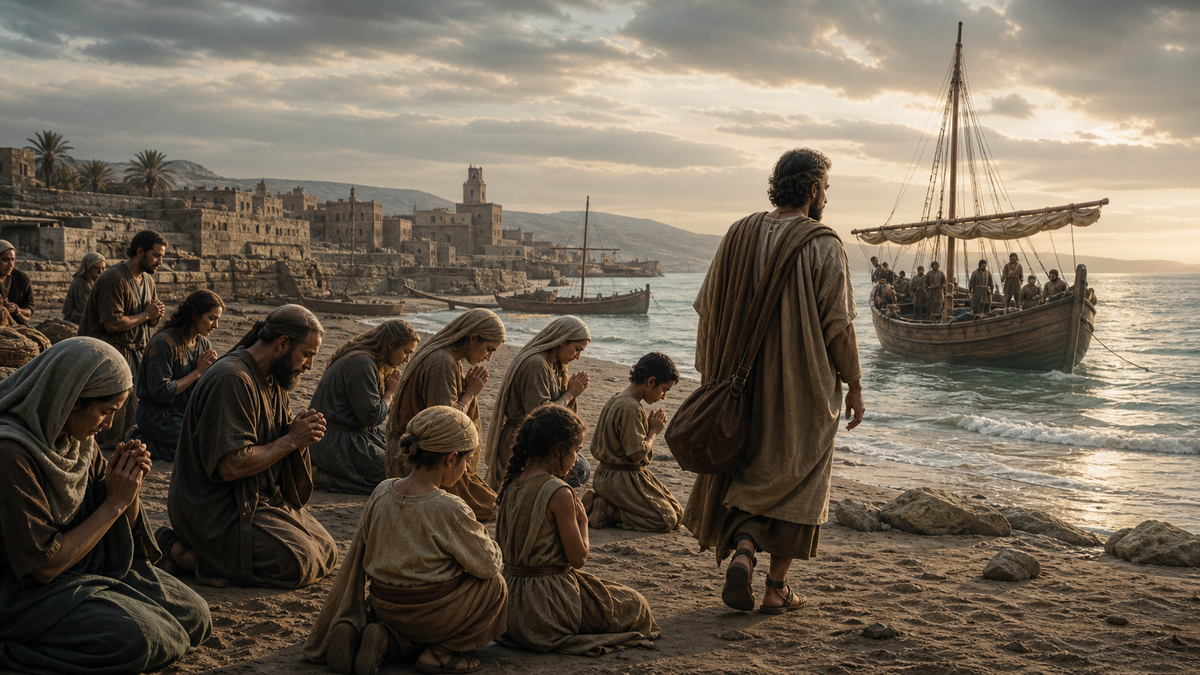
Acts 21… that very scene plays out on a beach in Tyre.
The Things We Cannot Stop
Acts 21:5-6 opens with families together. Wives and children, walking them out of the city. Everyone kneeling down on the beach to pray. Saying goodbye: “we said farewell to one another and boarded the ship, and they returned home” (CSB, Acts 21:6). Six words carrying the weight of separation. They got to go home. Paul did not. He was headed towards Jerusalem where chains were waiting.
This is where you recognize your own place. The child making a choice you warned about. The friend stepping toward the risk nobody would choose for them. You cannot stop them… though you want to, out of love. So you do what those in Tyre did. You kneel. You pray. And when that is not enough, you weep. These are the three things left when power abandons you.
A Voyage Mapped by Warnings
Paul journeys through ports: Cos, Rhodes, Patara, Tyre, each one a place he could have turned around. At each port, the Spirit speaks (Acts 20:23). Luke’s word choice matters. When Paul leaves the Ephesian elders at Miletus, Luke writes: “After we tore ourselves away from them” (CSB, Acts 21:1). The word is… torn away. Not “departed.” Ripped.
That word echoes one other time in Luke’s gospel. Luke 22:41. A garden at night. Jesus “withdrew [tore away] from them about a stone’s throw” to pray prayers of blood and sweat. “Not my will, but yours, be done.” Luke is putting Paul’s journey in the shape of Jesus’s last night. Watch for it.
At Tyre, the ship stops to unload cargo. But disciples are there. Acts 21:4: “Through the Spirit they told Paul not to go to Jerusalem” (CSB). If the Holy Spirit told him not to go, why did he go? Fair question. Now watch what the text is careful to show us. Who tells Paul? They do. “Through the Spirit they told Paul.” The Spirit is the source of their knowledge, not the author of a command. The disciples warn him. Out of love and desire to spare Paul the chains awaiting him. But when Agabus arrives, a prophet with a track record, he speaks a formal prophecy: “This is what the Holy Spirit says” (CSB, Acts 21:11). Bound. Delivered. Handed over. Confirmed again for Paul.
The Commission Was Already About This
Paul’s story reaches back twenty-six years.
Paul, blind on the Damascus road. Acts 9:15-16. The Lord tells Ananias: “This man is my chosen instrument… I will show him how much he must suffer for my name” (CSB). The Greek word is dei: divine necessity. Not “might.” Must.
Twenty-six years later, Paul stands in a crowd begging him not to go. And what does he say? “I am ready not only to be bound but also to die in Jerusalem for the name of the Lord Jesus” (CSB, Acts 21:13). That is his own words from the Damascus road. The suffering was not a surprise announcement. It was a kept promise. An answered commission. Not punishment. Purpose.
The Silence Fills Up With Prayer
This is where the text does something remarkable.
Acts 21:12: the crowd “pleaded with him not to go up to Jerusalem” (CSB). Begged. Pressed the case. It did not work. Acts 21:14: “Since he would not be persuaded, we said no more except, ‘The Lord’s will be done’” (CSB).
The Greek verb means: we fell silent. What fills the silence is a prayer, and Luke writes it reaching all the way back to a garden.
Matthew wrote about Jesus in the garden of Gethsemane. Mark wrote Gethsemane. They recorded Jesus praying: “Not my will, but yours, be done” (Matthew 26:39 CSB; Mark 14:36 CSB). Luke wrote it the same way in his gospel. But Luke does something Matthew and Mark did not. Luke takes that same prayer, the same words for will and be done, and puts it on the lips of the church at Caesarea. “The Lord’s will be done.”
Luke’s words. Both times. Jesus and then the Church.
Jesus prayed it alone in a garden, no friends, no crowd, no one trying to save him. That is how alone he was.
Between Gethsemane and the church, the tomb was emptied.
The Difference the Tomb Made
The church at Caesarea prays in the light of an empty tomb. They have seen what happens when God’s will is done. They know He did not stay dead.
This is why Red River Baptist Church can pray “the Lord’s will be done” with tears and hope in the same breath. Because the will being done is the will of Someone who prayed this first all the way to the cross and then the tomb… And lived.
The Cross Is God’s Answer
The question: Why would God let this happen? The Bible answers not with explanation but with a person. A presence, not an explanation. The silence says: I am with you in it. You are held while holding the question.
The Prayer Waiting for You
There is a prayer waiting for you.
Not a command. A prayer.
It is the prayer Paul’s friends prayed when words ran out. It is the prayer the early church said when they realized they could not protect their apostle but they could follow him into surrender.
“The Lord’s will be done.”
Maybe today, that is your line. Maybe you have been trying to negotiate with God for someone you love. Maybe you have been standing on a beach of your own, begging him to change course. And maybe today, you are ready to fall silent.
Not because you are resigned. But because you remember. The last time God’s will was done, the tomb did not hold. And neither will this.
The door is open to that prayer. The silence is wide enough for the prayer to show up.